
How Food Labels Can Help You Reach Your Goals
Food labels can be confusing with a traffic light system, percentages, graphs and grids. Let’s find out how to get the most out of what’s on food labels.
Those teeny little numbers on the side of packs that you ignore. Yep, labels. They’re your best friend when it comes to healthier eating and losing weight and here’s why.
What are food labels for?
Put simply, they’re loaded with information. Labels list ingredients in weight from biggest to smallest, along with the energy the product provides, measured in units called calories (kcal). Often displayed as a grid or table, they show the number of calories, fat, sat fats, carbs, sugar, protein and salt it contains.
Information is provided per 100 grams and sometimes per recommended portions too. Labels are a legal requirement for packaged foods. There are some exemptions, which include fresh uncut fruit & veg, herbs & spices, tea, coffee, flours, some vinegars, and alcoholic drinks above 1.2%.
The guidelines below tell you if a food is high in fat, sat fat, salt, sugar or not. If you’re trying to lose weight, it can be useful to know what’s in your food so you can make decisions that fit with how you want to eat.
Total fat
High: more than 17.5g of fat per 100g
Low: 3g of fat or less per 100g
Saturated fat
High: more than 5g of saturated fat per 100g
Low: 1.5g of saturated fat or less per 100g
Sugars
High: more than 22.5g of total sugars per 100g
Low: 5g of total sugars or less per 100g
A note on sugars: manufacturers use lots of words to describe forms of sugar, these include syrup, barley malt, molasses, honey, fruit juice concentrate and words ending in ‘ose’ like fructose, sucrose, dextrose and maltose, so look out for these.
Salt
High: more than 1.5g of salt per 100g (or 0.6g sodium)
Low: 0.3g of salt or less per 100g (or 0.1g sodium)
Red, Amber, Green – the traffic light system
The front of supermarket packaging often features a traffic light label. By using red, amber, and green colour coding, you can tell quickly if a food has high, medium or low amounts of fat, saturated fat, sugars and salt:
- Red means high levels
- Amber means medium levels
- Green means low levels
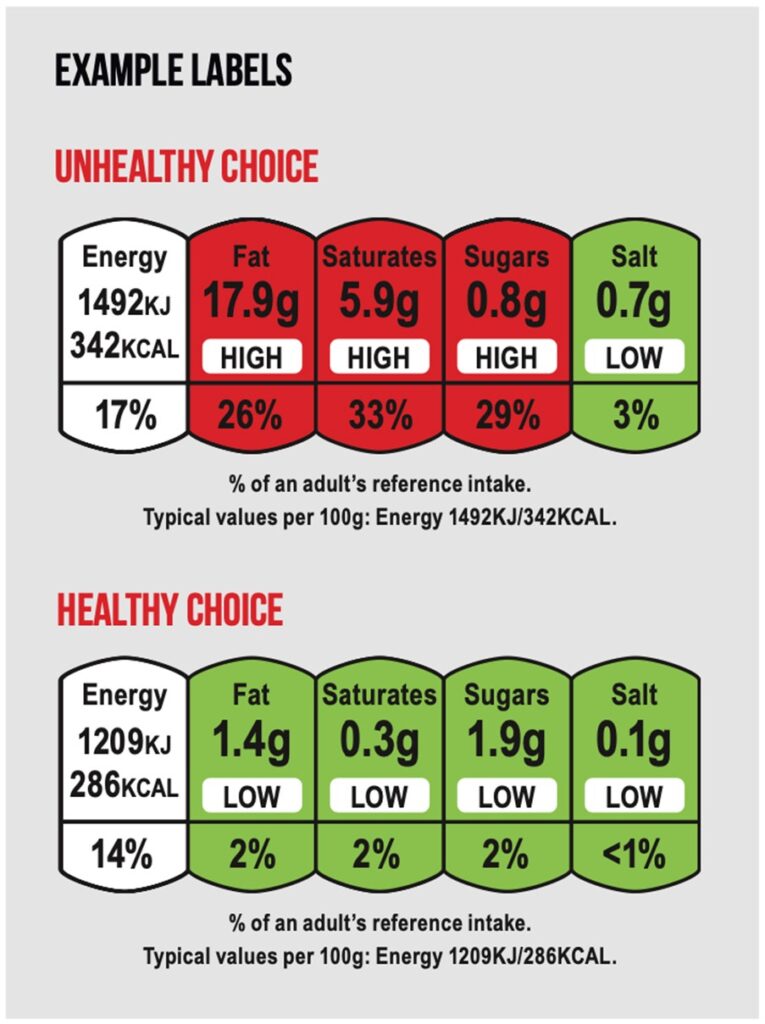
Be aware that often a manufacturer’s serving size may be different to our portioning. You might dish up twice as much as their serving size suggests.
You’ll also see calories/energy represented on food labels as a percentage of an adult’s daily recommended intake.
Top tips for understanding food labels
- Total fat, saturated fat, sugar and salt are the most important to monitor and reduce for the sake of your health.
- Red levels on packaging do not necessarily mean foods you need to avoid. This is because some foods may have red levels of sugars and fats but still benefit your health. Take muesli with dried fruit, for instance. It may be red on sugars due to the dried fruits, but it contains valuable fibre you need in your diet. Or salmon stir fry. It may be red in fats but it’s rich in omega 3 fatty acids which are of great benefit to you. Get to know your labels and let them help you make great decisions.
- Be mindful of your portion control.
- Use the per 100g column when comparing foods as serving sizes often vary.
- Remember, even healthier packaged foods may be higher in calories and fat/sugar/salt than their homemade equivalent – plus you can usually save money by making meals from scratch too. Win win.
For a healthy, balanced diet, the NHS guidelines recommend you:
- eat at least 5 portions of a variety of fruit and vegetables every day.
- base meals on potatoes, bread, rice, pasta or other starchy carbohydrates – choose wholegrain or higher fibre where possible.
- have some dairy or dairy alternatives, such as soya drinks and yoghurts – choose lower-fat and lower-sugar options.
- eat some beans, pulses, fish, eggs, meat and other protein – aim for 2 portions of fish every week, 1 of which should be oily, such as salmon or mackerel.
- choose unsaturated oils and spreads, and eat them in small amounts.
- drink plenty of fluids – the government recommends 6 to 8 glasses a day.
Read the label, win the battle
Next time you’re doing the big shop, have a proper look at those labels instead of just chucking things in the trolley. Spot a red light? See if there’s an amber or green alternative that still hits the spot.
Little swaps like that make a big difference over time and your waistline will thank you for it.
Spotted any decent low-fat or low-sugar finds? Stick them in the MAN v FAT group chat and help a mate out!
And because we love a bit of fun with our facts, here’s our very own MAN v FAT nutrition label – how does it stack up against you?